Form Funnel Submission Module
Form Funnel That Converts Anonymous Traffic Into Actionable Demand
This module addresses lost demand by restructuring how prospects move from interest to submission. Conversion reliability improves through reduced upfront friction and a clear post-submission path. Field ordering prioritizes commitment and intent, increasing completion rates and downstream qualification quality.
Reframing the Form as a Revenue-Critical Decision Point
The original form represented a common failure point where high-intent traffic was lost due to immediate cognitive and time demands. Requiring full disclosure upfront reduced submission rates and filtered out viable prospects prematurely. The absence of booking integration and post-submission direction left momentum unmanaged, increasing drop-off after expressed intent. The redesigned funnel reduced early friction through segmented data capture, introduced an explicit post-submission path, and reordered inputs to escalate commitment progressively. This approach preserved demand, improved lead quality, and created a controlled transition into scheduling and sales follow-up.
01
Home Page (Acquisition & Positioning)
Captures initial attention and positions the offer clearly, converting anonymous visitors into motivated inbound leads.
02
Form Funnel
Qualifies and routes leads through structured questions, surfacing intent early while filtering out low-fit inquiries.
03
Sales & Executive Dashboard
Centralizes deal activity and priorities, allowing for real-time visibility over the pipeline, and transforms activity into actionable insights.
04
CRM & Kanban
Structures lead records, deal stages, and activity history into a disciplined pipeline that ensures consistent follow-through and accountability.
Hidden Revenue Loss
Form Funnels Quietly Undermine High-Intent Demand
Form funnels fail in ways most teams do not monitor or diagnose. Unlike home pages, forms handle visitors who have already signaled intent and readiness. When this stage breaks, revenue is lost after interest has already been earned, making the cost of failure significantly higher.
01
High-Intent Traffic Is Treated as Low-Value
Forms often apply the same friction to all users, regardless of intent strength. This forces qualified prospects to overcome unnecessary effort. As a result, viable opportunities exit despite already wanting to engage.
02
Drop-Off Occurs After Commitment, Not Before
Visitors reaching a form have crossed multiple decision thresholds. Losing them at this point represents wasted acquisition spend and lost revenue potential. The business impact compounds because these users rarely return.
03
Lack of Direction Causes Intent Decay
Without a defined post-submission path, momentum collapses immediately after intent expression. Prospects are left unsure of next steps. This gap reduces scheduling rates and weakens sales follow-through.
Demand Capture Strategy
The Form Funnel Was Rebuilt to Preserve Intent and Increase Conversion Reliability
The solution reframes the form as a revenue safeguard rather than a data collection step. Business risk is reduced by aligning friction with demonstrated intent instead of applying uniform resistance. Momentum is preserved through structured commitment and explicit next-step signaling.
Friction Is Segmented to Match Intent Strength
High-intent visitors are treated as higher value by reducing unnecessary early demands. Commitment is protected by delaying heavier inputs until intent is confirmed. This preserves lead quality while preventing premature abandonment.
Conversion Is Reinforced Through a Clear Value Exchange
Drop-off is reduced by pairing submission with an immediate opportunity for diagnostic engagement. Offering a discovery or diagnosis call reframes submission as reciprocal value. This increases willingness to complete and commit.
Momentum Is Captured at the Point of Maximum Readiness
The funnel channels interest into scheduling while intent remains active. This shortens the gap between expression and action. Sales opportunities become time-bound rather than passive.
Post-Submission Uncertainty Is Systematically Removed
A defined confirmation path reassures prospects after submission. Clear next steps reduce anxiety and hesitation. This stabilizes follow-through and improves downstream engagement quality.
System-Level Execution
A Sequential Walkthrough That Converts Intent Into Structured Engagement
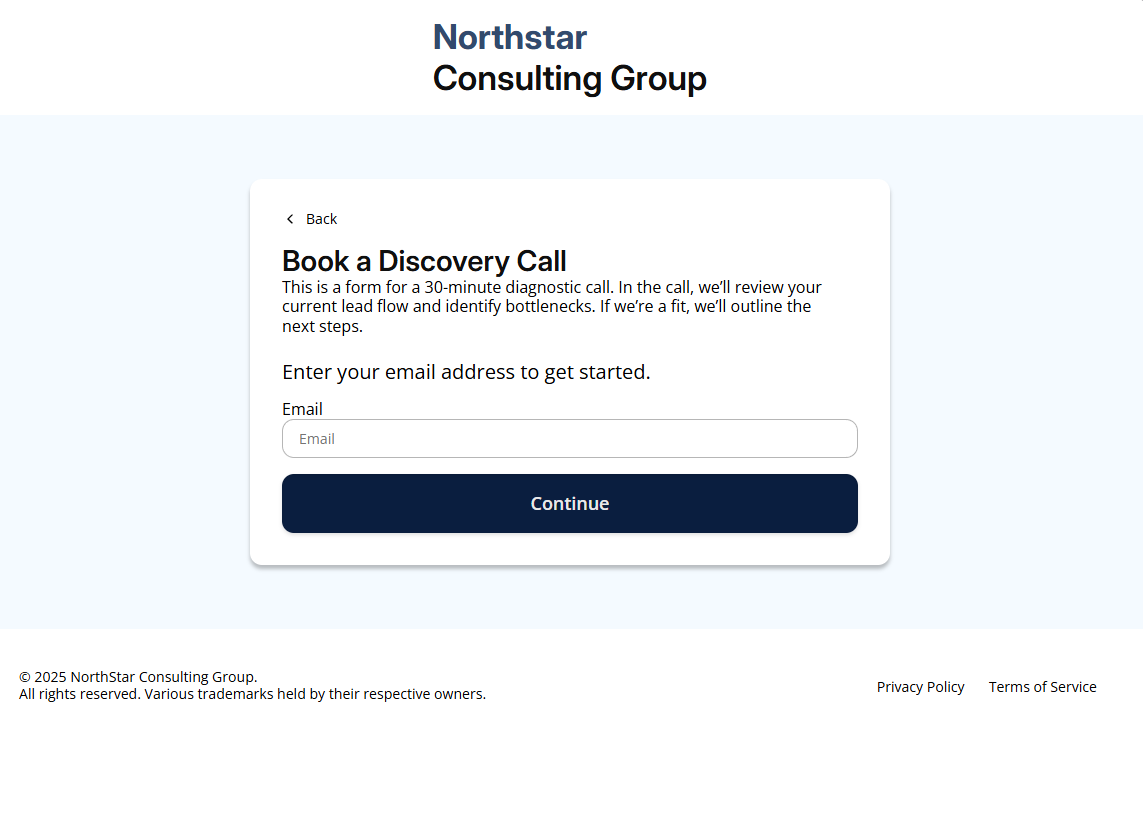
The walkthrough demonstrates how intent is captured without overwhelming prospects at the first interaction. Initial commitment is established through a low-friction entry point that encourages continuation rather than resistance. Subsequent stages progressively formalize the relationship through account details, scheduling, and confirmation. Each step maintains momentum while guiding prospects toward a defined engagement path with NorthStar.
Initial Commitment Capture
Low-Friction Entry Secures Early Intent Without Premature Resistance
The email-first entry captures intent with minimal effort, reducing cognitive load at the point of highest abandonment risk. Early commitment increases follow-through by leveraging consistency effects. This protects high-intent traffic from exiting before value exchange is established.
Progressive Qualification
Expanded Intake Converts Interest Into Actionable Sales Context
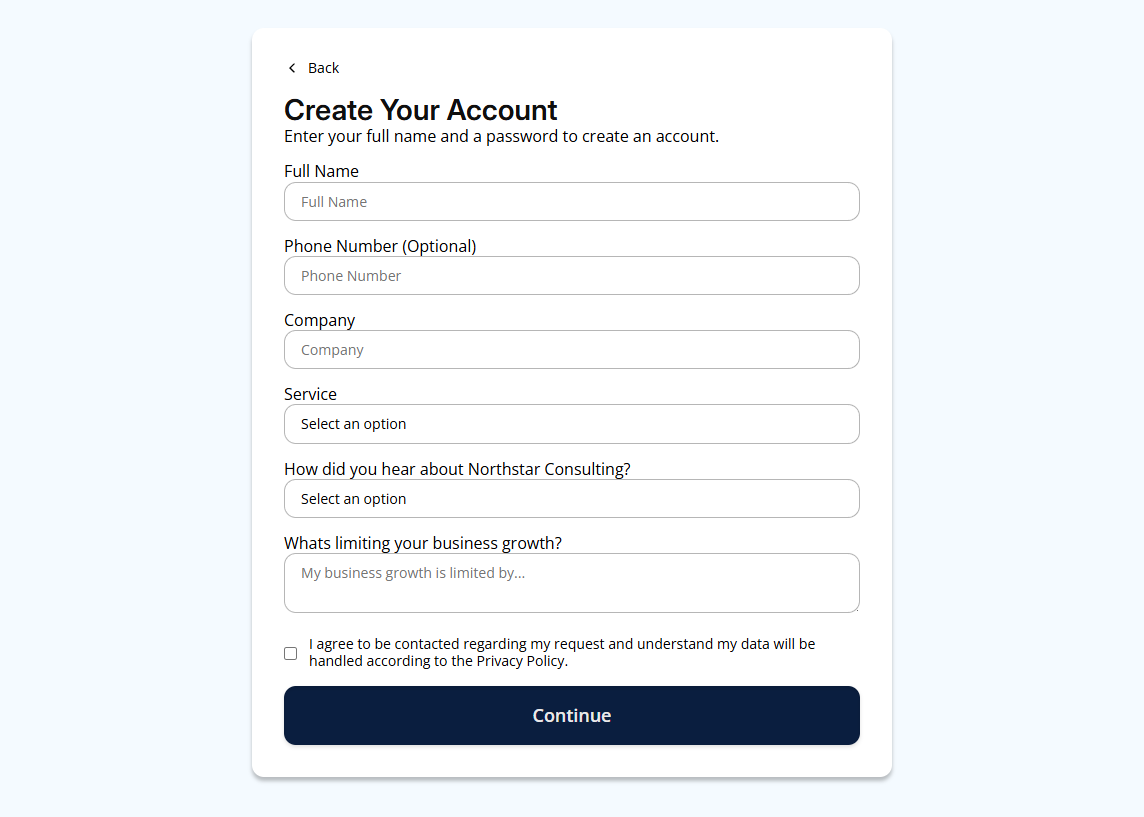
The full form gathers sufficient business context to enable informed sales action without overwhelming earlier stages. Optional fields introduce self-selection signals without disqualifying viable leads. This balances conversion volume with downstream qualification quality.
Momentum Conversion
Scheduling Integration Channels Intent Into Time-Bound Opportunity
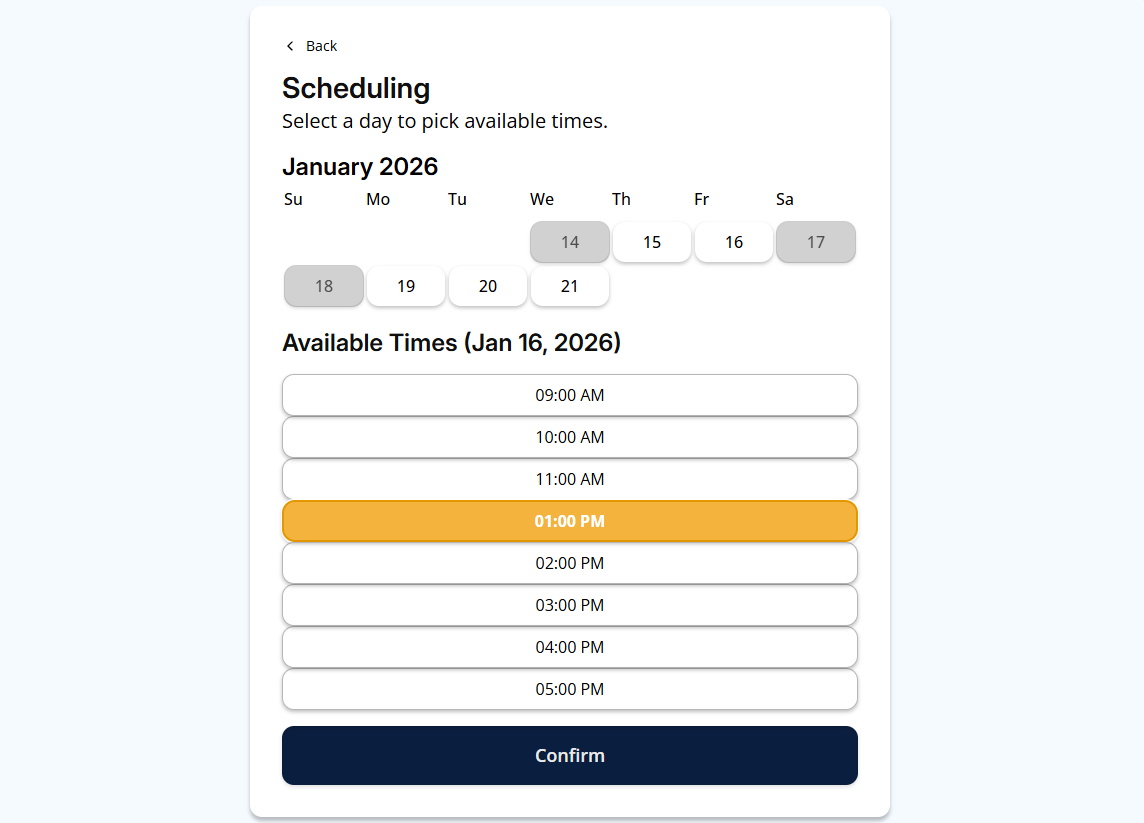
Scheduling is introduced when readiness peaks, transforming passive interest into committed action. This reduces lag between submission and engagement. Sales efficiency improves as opportunities become calendar-bound rather than follow-up dependent.
Post-Submission Assurance
Confirmation Path Removes Uncertainty and Stabilizes Follow-Through
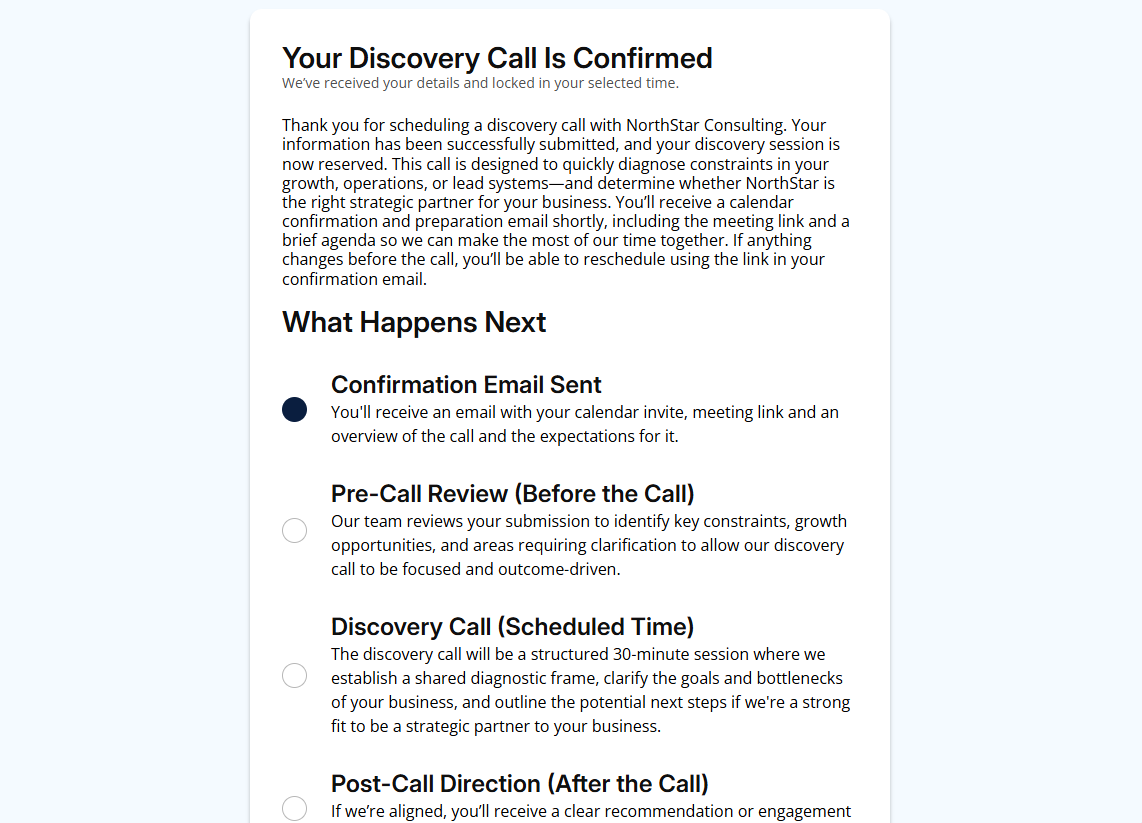
The confirmation screen clarifies next steps immediately after submission. Reassurance reduces second-guessing and post-action hesitation. This strengthens engagement continuity and improves response rates in subsequent interactions.
OUTCOME
The Form Funnel Improves Conversion Quality While Reducing Sales Friction
This module increases realized demand by protecting high-intent traffic from premature abandonment. Conversion outcomes improve through aligned friction, clear value exchange, and structured next steps. Sales teams receive fewer but more actionable opportunities with higher readiness and context.
-
Higher Capture of High-Intent Demand
Submission rates improve because early friction is reduced without lowering lead quality. Prospects who would previously abandon are retained through progressive commitment. This directly increases revenue from existing traffic sources.
-
Improved Sales Efficiency and Readiness
Leads arrive with clearer intent, context, and urgency due to structured intake and scheduling. Sales follow-up shifts from chasing responses to conducting prepared conversations. This shortens sales cycles and reduces wasted outreach effort.
-
Greater Visibility Into Conversion Health
Each stage of the funnel creates observable signals around intent and drop-off. Teams gain clarity into where demand is preserved or lost. This supports informed optimization decisions instead of assumptions.
Apply a Form Funnel That Protects High-Intent Demand
This case study demonstrates how small intake decisions materially affect revenue outcomes. Treating forms as systems preserves intent, improves conversion quality, and reduces sales waste. The same approach can be applied to your acquisition flow to capture more value from existing traffic.